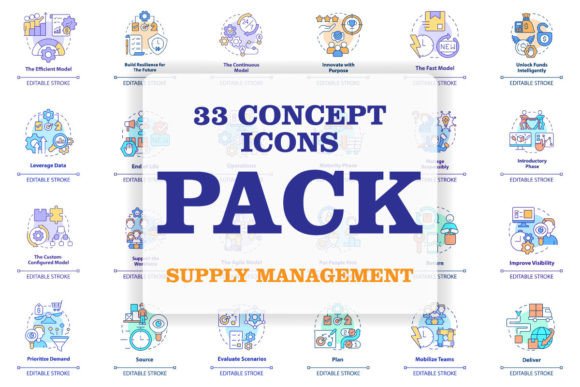
Supply Chain Management Concept Icons: A Strategic Toolkit for Visual Communication
In the complex world of business, clarity is power. For professionals managing the intricate flow of goods, information, and finances from supplier to customer, conveying concepts quickly and effectively is a daily challenge. This is where a specialized set of Supply Chain Management Concept Icons becomes more than just graphics; it transforms into a strategic toolkit for visual communication. These are not random symbols. They are thoughtfully designed, isolated icons—each representing a core component like procurement, logistics, warehousing, or inventory control—crafted to streamline planning, enhance presentations, and solidify branding across all your operational narratives.
The Strategic Utility of a Unified Visual Language
Why dedicate resources to a cohesive set of icons? The answer lies in the cognitive efficiency and professional cohesion they provide. When every team member, from the marketing department creating a brochure to the operations team drafting a process infographic, uses the same Supply Chain Management Concept Icons, you establish a unified visual language. This consistency reduces ambiguity, accelerates understanding, and reinforces key concepts. Using a set where each icon has an editable stroke, as in the BSD Studio collection, allows you to adapt the visuals to your specific brand palette or project theme without losing the foundational meaning. This flexibility is crucial for applying the icons across different mediums—from mobile app screen pages to annual report infographics.
Planning and Positioning with Visual Precision
Strategic planning often involves mapping out processes that are abstract or multifaceted. A set of Supply Chain Management Concept Icons serves as a visual shorthand, enabling you to build flowcharts, Gantt charts, or strategy maps that are immediately intelligible. For instance, using a distinct “global sourcing” icon versus a “local supplier” icon in a procurement strategy document visually positions your sourcing philosophy before a single paragraph of text is read. This visual precision aids in internal alignment and helps external stakeholders, such as investors or partners, grasp your operational model and competitive advantages rapidly. The use of clean, thin-line color illustrations on a transparent background (PNG, SVG) ensures these icons integrate seamlessly into any existing planning document or digital platform.
Practical Applications Across Business Functions
The utility of these icons spans the entire organization. Consider a marketing team developing a customer-facing brochure to explain your company’s reliable delivery network. Integrating icons for “transportation,” “tracking,” and “last-mile delivery” from a consistent set creates an infographic that is not only attractive but instantly educational. For trainers and educators within the company, these icons become vital teaching aids, simplifying complex topics for new hires or cross-functional teams. Freelancers and consultants can leverage the icons to elevate their client deliverables, providing clear, professional-looking process diagrams that enhance their perceived expertise and value.
- Internal Communication: Use icons in slide decks for stakeholder meetings to visually summarize warehouse automation plans or inventory turnover goals.
- Brand Consistency: Apply the same icon style (using the included Roboto-Medium and Myriad Pro-Bold fonts for labels) across all public and internal materials to build a strong, recognizable brand identity.
- Operational Documentation: Embed icons into standard operating procedure (SOP) documents or quality management system flowcharts to improve readability and compliance.
- Customer Experience: Incorporate icons into your app’s interface or service status pages to give customers a clear, intuitive view of the order journey.
Approaching Implementation with Intentionality
Adopting any tool requires intentionality to avoid wasted effort or mixed messages. Before integrating Supply Chain Management Concept Icons into your projects, start with a clear goal. Are you aiming to simplify a training module? Standardize departmental reporting? Enhance a sales proposal? Define the primary objective. Next, audit your current materials. Identify where text-heavy explanations could be replaced or supported by a visual concept. Then, selectively apply the icons. The key is not to decorate every page with every icon, but to use them purposefully where they add the most cognitive value—to explain, to summarize, or to highlight a critical step in a process.
Risks of Context-Free Use and How to Mitigate Them
The primary risk of using any conceptual icon set without clear goals is creating confusion instead of clarity. If icons are applied inconsistently—using different symbols for the same concept in different documents—you undermine the very unity they are meant to provide. Another risk is overuse, which can clutter a document and dilute the impact of key information. To mitigate these risks, establish a simple internal guideline. Create a one-page reference sheet that maps each icon to its agreed-upon business concept (e.g., “Icon #7 = Cross-Docking”). Ensure all teams with access to the product file formats (EPS, AI for editing, JPEG for quick use) also have this guideline. This turns the set from a collection of pretty graphics into a governed corporate asset.
Long-Term Value and Creative Scalability
Investing in a well-designed, editable set from a provider like BSD Studio, which offers new topics and discounts weekly, provides long-term strategic value. As your business grows and your supply chain evolves, you will need to diagram new processes, explain new services, and train on new technologies. A scalable icon library that you can adapt (thanks to editable strokes and multiple background formats) prevents the need to source new visuals haphazardly for each new project. This consistency, maintained over years, becomes part of your organization’s visual heritage, making historical documents easily understandable and future communications inherently aligned with your past. Subscribe to such a studio to ensure your toolkit evolves alongside business trends.
Ultimately, Supply Chain Management Concept Icons are a decision-making aid. They help you, the professional, entrepreneur, or educator, decide how best to convey intricate information. Their thoughtful use supports not just productivity and creativity, but better outcomes: clearer training leading to fewer errors, stronger proposals leading to more clients, and cohesive branding leading to greater trust. By choosing a robust set and implementing it with strategic intent, you turn a simple collection of symbols into a powerful ally for achieving your operational and communicative goals.